Pages

Friday, June 19, 2009

Lip Grip is OUT!


http://ofieldstream.blogspot.com/p/lip-grip-out-page-decal-code.html

GrabIt!
Put this banner on your site, blog, forum, Facebook or other online presence. Click GrabIt!
http://lake-link.com/radio/audio_files/Show_425.mp3
Click on Show 425 for interview w/ Les Booth on Lip-Grip is Out! Interview runs
18:10 thru 29:15
We've all seen it done.

On TV, in magazines and books, at every tournament and all over the Internet. All - of us if we're truthful! - have done it. Many still do. Many more will, unfortunately, continue to do it. Despite the facts. The results of this all-to-common action, is death. What is it you say?

The answer is: the Horizontal-One-Hand-Lip-Grip-Hold.

You know, the one. Yeah, it's grip part of the 'Grip-n-Grin'; used to show off that beautiful big bass you've just caught. Showing you holding your trusty rod & reel; kissing 'da bass, 'Dance Style'; mugging for the camera - someone else or, worse yet!, a self-portrait; encouraging envy among your fishing party ... and many other routinely justified purposes.

It may be popular and one could even say, "Well, everyone is doing it!" And about that part, you would be correct; nearly everyone IS doing it. But, there is no support for continuing to do it.
Fishermen must STOP USING
this damaging hold and STOP NOW!

Here's HOW and WHY we must stop the damage.

Despite the fears of some, we can fish, enjoy the catch and protect the resource. If we execute the process correctly, we can also begin to regain credibility among the non-fishing population.

The Problem: Gripping the lower lip (dentary), while holding the fish horizontal with one hand. Thus, forcing the entire body weight of the fish to be supported at the operculum fulcrum point [OFP](jaw).

The Result: The muscles, ligaments and sinew connecting the OFP with the rest of the skeleton and supportive muscles and tissue, are subjected to extreme flexion. At the minimum, such a hold will expose the fish to severe muscle stress and strain, resulting in an inability to use the systemic complex for eating. This puts a fish at high risk of being a fatal release. In the worst case, the stressed muscle and cartilage are damaged, along with the connecting tissue, with possible socket dislocation. This would be roughly, a broken jaw, and a 100% post release mortality: aka, dead fish.

History of 'Lip Grip' method: This technique has been around since bass have been caught, landed and admired. However, since the advent of TV Fishing shows many more people are now suddenly influenced by the visual experience. A far more effective and powerful medium, TV, than the photos published in outdoor magazines, its influence: in this case: is tragic.

TV fishermen such as Roland Martin and Bill Dance became celebrity's for their action-packed fishing display antics. Because of the outdoor TV personalities growing popularity and the desire of people to emulate, the problem has been perpetuated and a damaging trend established. It's now an extensive problem and needs to be reversed. Far too many bass - many of trophy size - are ending up as turtle food that were released with the intention of maintaining a healthy recreational fishery.

The 'lip grip' problem is not as pervasive with 'toothed fish' - for obvious reasons. This is not to say they are free from the problem. Mechanical devices such as the boga-grip, if improperly used, will also cause serious damage to the fish.

Cause of the PROBLEM: It's a muscle thing. Bass (all sunfish) eat by sucking prey into their buccal cavity (mouth). Open Jaw > Suck in water and prey > close Jaw > expel water out gills > swallow prey (food). It is that simple. However, the force generated to perform the 'suck', is considerable and requires a great deal of muscle strength. The muscles needed to do this are all jointly connected to the operculum fulcrum point (OFP). This is the same point where, in an improperly held fish, all the pressure of the fishes body weight - suspended without support - is focused. When those muscles are strained or injured; let alone torn; the ability to generate the suction necessary to capture prey is greatly reduced or, eliminated.

Recovery time is proportionate to the severity of the injury. In studies conducted on the suction power generated during feeding, results have shown the stresses generated during the feeding process to be just short of resulting in injury. Thus, a fish with an injured muscle or set of muscles, needed for feeding, is just not going to be able to eat. A fish that cannot eat is a dead fish. The dangerous complexity of such a scenario is compounded with a competitive population density for available prey, the mortality probability rises to unacceptable levels. This is a problem that can - and should - be totally avoided.

Solutions: There are several workable solutions to alleviate the problem inherent in the 'lip grip' technique.
  • simply holding the fish with two hands, in a horizontal position will work best.
  • a purely vertical hold, by the lower lip (dentary) will work on smaller fish.
    • Large bodied bass - actually all fish over 3lbs - suffer an elevated potential for internal damage from the vertical position and thus should be avoided.
  • use of mechanical lip-grip tools have been widely publicized. These tools work very well on restraining large fish - especially those with teeth that obviate a 'lip grip' by hand or to remove aggressive hooking methods (treble and barbed hooks) in fresh and saltwater. They are, however, not without their damage potential and controversy.
    • Studies on popular sport angling fish species, like the tarpon and bone fish, have shown mortality rates as high as in the 80% range. Far too high to maintain any kind of a sustainable release population.
The best solution to the problem is:
  1. minimize handling of the fish using a Lite-Touch™ [1] method
  2. release in-the-water whenever possible (read: ALWAYS for big fish; safety for both fish and fisherman is primary with big, trophy sized fish. Big fish do damage to themselves, fishermen and tackle when removed from the water; a primary concern regarding the 'toothed fish'. 'Avoidance of any action that might cause harm to a non-harvested and to-be-released fish' - should be the prime directive for any large fish.)
  3. use barbless hooks for faster, easier removal
  4. use protective coverings on hands (wet, or glove) to minimize skin-to-scale contact
  5. keep the photo sessions short and in-the-water; when out-of-water photos are to be taken, do so with a full-body support hold; pre-wet your hands (dip your hands in the water BEFORE handling the fish - or better yet, wear protective holding gloves and pre-wet;
  6. then quickly return the fish to water.
The Lip-Grip is OUT. The Lite-Touch™ is IN!

[Read the first online commentary on this subject, posted on Bill Anderson's blog, Muskoka Outdoors 13 JULY 2006 .. http://muskokaoutdoors.ca/blog/2006/07/13/dont-kill-the-fish-you-release/ ... in which I commented on Bill Anderson's Muskoka Outdoors blog, regarding a bass he was holding in a vertical orientation]

[1] Lite-Touch™ (Pending) ... it's really quite a simple idea. Amazing isn't it, how simple methods do work the best.

Lite-Touch™ is just what is sounds like. If you are going to release a fish, instead of killing it, then follow the three...

Lite-Touch™ rules.
M+H+S = LFR

  • MINIMAL contact with the fish
  • HORIZONTAL, 2-hand-support... ONLY!
  • SHORT duration - DO NOT exceed a 2 minute maximum out-of-water-timeline!
  • M + H + S = LFR (Life Following Release)
It works. Simple as that.

---- Editors Notes ---

--05.13.11 NEW LOGO + Clarification + Links + Interview --

The article was updated to include the new (1) Lip-Grip NO! logo. (2) Minor, no meaning change, edits for clarification. (3) Expansion on the Lite-Touch™ terminology; typography; definition; and, addition of the M+H+S = LFR formula. (4) Links were added to the Lip-Grip NO! page of images and code, being made for public distribution. (5) A link to the Dan Small Outdoors Radio show interview of the topic Lip-Grip is Out!, was added under the Lip-Grip NO! logo.


--05.17.11  Clarification + Correction --

The article received additional editorial changes for clarification and a correction. (1) Clarifications were minor word corrections [ to > too; your >you're; a > an; etc.]. (2) Correction was for a typo error: operculum fulcrum joint was corrected to read operculum fulcrum point. Also two incorrect acronyms typos were corrected (3) from OFJ to OFP; and one additional (OFP) was added.


-- 08.06.12  Additional Information: Vertical-One-Hand-Lip-Grip-Hold--

We have seen the need to add - in addition to the Horizontal-One-Hand-Lip-Grip-Hold  we are including the equally devastating and potentially fatal, Vertical-One-Hand-Lip-Grip-Hold. Because fish live in an aquatic environment, developed for the neutral-buoyancy environment of water, it only stands to reason the connective tissue is not designed to endure the same strain imparted in an 'air' environment.

When a large fish is taken from its aquatic (water) environment, there is an immediate physiological shock to its system. The weight of its body parts are immediately translated across it's framework of skeletal and connective tissue.  If you are a hunter and a fisherman, and have participated in the 'butchering process', remember back to the 'toughness' of the tissue in a deer, elk, moose.. turkey even and other birds. Also, think about the bones of the mammals. How dense and strong they were.  And even though the bones of birds are less dense than mammals, they are also far denser than fish bones. There is a reason: GRAVITY.

On land, animals have the force of gravity pulling against their skeletal structure and all of the connective tissues holding the muscle to the bone: cartilage, tendon, other soft tissue; including blood vessels.  All organs are also adapted to the tug of gravity. So, all parts of a land mammal are already prepared for the force of gravity on them: inside and out.

Fish, on-the-other-hand, do NOT live in a gravity-affected environment. They live in the environment of Neutral Buoyancy; A near Zero Gravity environment.  This is why astronauts-in-training, train in water; to mimic the effects experienced by the zero-gravity environment of space.

The physiological effects, felt by a 'fish-out-of-water', are not unlike that of what humans who have been exposed to long-term space; where weightlessness contributes to bone loss; connective tissue delamination; muscle atrophy, hypoxia  and asphyxia.  Weightlessness; the apparent absence of gravitational pull; is the natural condition to which fish are accustomed in a 'water atmosphere'.  But humans are designed to function in an 'air atmosphere'. The same environment that offers no support for the fishes internal organs.

Additionally, blood flow and oxygen up-take (respiration: ie, breathing!) is made possible by the neutral buoyancy environment - for fish.  When on land, even if a fish can breath air; as a few species can; it is more difficult for them - to impossible - for the fish to get oxygen into it's blood.  Gravity pulls everything toward the center of the earth. For the fish this is 'away' from where it needs: blood to flow; oxygen to respire; food to digest; enzymes to mix; etc!  Fish do NOT work in gravity. PERIOD.

When we bring fish out of the water environment they live in, its just like we humans are when pulled into the water without auxiliary breathing; the aid of friction; the aid of gravity.  Without the effects of gravity, we cannot walk, our bones weaken; our connective tissue deteriorates; or blood thickens and flows slower ... we begin to die.  The same thing fish do when we pull them from their water environment into our gravitational environment.

If you are HARVESTING the fish.. fine. The fish is intended to die and be used for food.  BUT..!!!  - IF the fish is intended to be returned, vis-à-vis, Catch-n-Release, then removing the fish from the water, for any length of time is putting the health, if not the life, of the fish in danger: UNNECESSARILY. 

Some fish are tough. Others are not. But it is better to 'ere' on the safer side and treat all fish as if they just cannot be removed from the water: IF the fish is intended to Caught-and-Released.

Adding this bit of Outdoor Wisdom to our interaction with the precious resource we know as Nature, will only strengthen that relationship and provide increased assurance that Nature will still be accessible; available; healthy; and .. around.


 -- 07.22.16  Additional Information: Ontario Fisheries Study--Catch-and-release angling: A review with guidelines for proper fish handling practices - S.J.Casselman, Fisheries Section, Fish and Wildlife Branch, Ontario Ministry of Natural Resources - July 2005  http://goo.gl/ea9bxp

The  Executive Summary from the Study...


The use of catch-and-release practices by anglers is increasing.  This increase is a result of both anglers viewing the process as a conservation technique and also because catch-and-release practices are being mandated by fisheries managers.  Despite the widespread use of catch-and-release, there is generally a lack of understanding regarding the mortality caused by the practice and how variation in catch-and-release techniques may affect the level of mortality.  

Fortunately, the increase in catch-and-release practice by anglers has coincided with an increase in research examining catch-and-release practices.  While most of the studies to date have been species specific, there are general recommendations that can be made based on the available information.  

While catch-and-release is physiologically stressful, stress and therefore mortality can be minimized by following some general catch-and-release guidelines.  Gear should be appropriate for the species being angled, allowing for quick retrieval.  The use of barbless hooks and circle hooks should be considered to reduce the amount of time required to release fish.  Air exposure should be minimized and fish should be released quickly. 

Depth of capture, hooking location and bleeding should be taken into account when deciding on whether or not to release a fish.   When performed correctly, catch-and-release can be successful with minimal harm to the fish and should be encouraged.  However, due to the variation among species in response to catch-and-release techniques, it is recommended that further research is needed to create species-specific guidelines.    

From the Introduction ...

One of the key components to the increased use of catch-and-release practices, both by anglers and fisheries managers, is the assumption that fish which are released actually survive the experience.  This assumption comes from the observation that when fish are released after being caught they generally swim away, apparently unharmed.  However, research indicates that most mortality occurs some time after release (Muoneke and Childress, 1994), thus fish that appear healthy upon release may later exhibit injuries or distress caused by catch-and-release practices.  Given the potential impact of mortality on the success of catch-and-release as a management practice, there is an increased demand to understand the level of mortality caused by catch-and-release and determine how various factors may affect catch-and-release survival.

The impact of mortality caused by catch-and-release practices is often underestimated by both anglers and fishery managers.  From a review of 118 catch-and-release studies (Appendix 1), which, in total, involved over 120,000 fish, the average mortality associated with catch-and-release angling was 16.2%.  Thus, while many anglers may assume that by practicing catch-and-release they are having no impact on the fish population, a significant number of released fish may die.  Additionally, many anglers will continue to fish after they have caught their limit under the premise that they will release all further fish caught, however they often do not take into consideration the number of fish which will inadvertently be killed as a result of this practice.  

 From the Catch-and-Release Guidelines..


Handling and Photographing a Fish
  • Keep fish in the water as much as possible to minimize air exposure.
  • Never place your fingers through gills or in the eyes.
  • Don’t hold heavy fish by the jaw as this may damage the jaw and vertebrae.
  • Hold large fish horizontally and support its body to avoid damage to the internal organs.
  • Use wet hands or wet cloth gloves to handle the fish.
  • Have camera ready prior to landing fish to minimize air exposure.
  • If possible, photograph the fish while in water.

 The BOTTOM LINE... 

How you handle a fish DOES make a difference in whether or not THAT fish lives to fulfill the mission of Catch-n-Release:

Catch and release fishing improves native fish populations by allowing more fish to remain and reproduce in the ecosystem. This practice provides an opportunity for increasing numbers of anglers to enjoy fishing and to successfully catch fish.   - Catch and Release Fishing: National Parks Service U.S. Dept. of Interior  (brochure - https://www.nps.gov/cuva/planyourvisit/upload/fishing%20brochure.pdf )

Catch & Release works ONLY IF you 
HANDLE and RELEASE fish CORRECTLY

----


Sunday, August 24, 2008

Me and Joe Went Fishing

"Me and Joe went fishing on Wednesday night. Where we went ....",

OK, I can hear the groans already. "NOT another so-called, 'Me and Joe' story." Well, I'm with you on that. I've had enough of those old brag-pole, exploit riddled tales, too. But this is NOT just another, 'Me and Joe'. This is a real life, honest-to-goodness, Me (Les Booth) and Joe (Joe Cornwall) fishing story. It's not what you'd expect. Really!

If you're looking for photos of big, football shaped bucket-mouth bass, or platter sized bluegill, or rod straining trout, then you will be disappointed. This is not a story about 'CATCHING' or 'SPECIES PORN'. This is a story about two guys who have known each other for several years in the online world of email, web sites, blogs and podcasts, finally getting to meet, face-to-face, in their favorite venue: fly-fishing.

We both belong to the Outdoor Writers Association of America and dance among the digital wave of New Media. But until Wednesday night, 20 August 2008, we'd never met in person.

Earlier this spring, I had a hit on a real fishing treat, come in from a contact, made over a year earlier. This was to be a real, rare treat, too. A mid-state Ohio group, specializing in breeding huge trout and placing them into recovered natural streams in central Ohio, offered me and up to three friends, a 'taste of trout fishing Nirvana'. I jumped on it. Inviting my best fishing buddy on the blue orb, Ed Hauser, my son and the one fellow from the 'Ohio' area whom I just knew would really appreciate such a rare experience: Joe Cornwall. Well, as luck would have it, Mother Nature was destined to rain on our parade. She decided to dump an unseasonably high rain event right over the 'Nirvana' and our plans were dashed. We patiently requested a 'rain check' and were granted it by the owners. When that happens, I will - well... maybe ... tell you all about it. But once again Joe and I were to remain 'virtual' acquaintances only.

Not quite a month later, I invited Joe to come to my neighborhood to fish my 'Home Waters' for my personal favorite game fish, the explosive and every entertaining, Smallmouth bass. That also happens to be Joe's favorite piscatorial delight, as well. Though the hallowed waters have held all summer, work, events and well -- life, conspired against our futile attempts in setting and consummating a successful outing. Thus, the "Home Waters" venture remains a future event.

Then three weeks ago, I receive an email from Joe saying he would be passing through Lafayette on his way from a business meeting in Chicago, on his way to another one the next day in Evansville. He wanted to know if he chose to stay in Lafayette, would I be interested in getting together and could I possibly have a bass pond where we could share a proper introduction: fishing. I fired back an immediate response, that I sure would and definitely could make that happen. All he'd need to do was tell me WHERE and WHEN to meet him and I'd be there with pontoons in tow and a fabulous water where we could go!

The die was cast. The day awaited. And the fishing gods smiled. So did me and Joe.

Me and Joe were going fishing!

It really was just that funny!

The weather last Wednesday was perfect. The temps were in the mid 70s, humidity in the low 40's and only an occasional breeze chopped the waters. Normally, I don't mind that chop, but for that evening I desired a still-as-glass water for the potential of explosive top water bass action. But, life experiences educate us to realize all requests posited to the divine - whether provided or not, are not necessarily what we truly need. Such was the case for this evening. For the waters were like glass and the top water action was full of potential - it was not found. However, something far greater came to hand.

We had just missed the 'bite' forecast by the Solar/Lunar Tables; having ended just 2 hours before we could get on the water. For some that would just plain terminate any reason for being on the water. What's the point? The likelihood of a 'real catch' was lost; might as well pull stakes and wait for the next window. Right?

I had long ago proven that such natural rhythms are good to pay attention to; they really do work. Equally, I have learned it is wise to neither dump all your eggs into one basket or believe in only a single line of thinking. When interacting with the flow of nature, flexibility is the KEY to a lasting and continual level of success. Have all the information you can have, but be willing to adjust on the fly (yes, all puns are willfully and gratuitously accepted!)

We missed it. But, we still caught fish. This is neither a chock up for or against the block of fishermen who either swear by, or swear at the 'tables'. Really, there isn't a need to waste your time in trying to be in either camp... if you're going fishing. For you see there in lies the understanding of the KEY to flexibility.

There is a huge difference between FISHING and CATCHING.


'Cause you see... Me and Joe had come to fish.
  • Fishing has no agenda beyond the moment. Catching demands outcomes.
  • Fishing doesn't equate success with quantity. Catching doesn't exist without it.
  • Fishing is ecumenical on all levels of human experience. Catching is purely denominational.
  • Fishing allows - even welcomes and seeks - serendipity. Catching fears and loathes it; demanding engineering precision.
  • Fishing is fun. Catching is work.
  • Fishing is open to anyone. Catching is a closed fraternity.

Me and Joe were fishing.

Me and Joe weren't looking for food. And that is the difference. Had we needed food, we would have gone fishing with catching as the objective. Catching fish was never our objective.


Getting to know each other over a good catch-basin of protein rich water, while amply plying the combined techniques of fly-casting, fly selection and observation, interwoven with a sublime mix of individual solitude and in-depth conversation on a wide ranging array of topics, was the objective. And I must admit, we hit the nail, squarely on the head! Bingo! Success on the highest level possible. We accomplished what we set out to do ... and then some.

Our fishing including not only seeking serendipitous encounters of an ichthyologic kind, but we were fishing the personal waters of our own lives. Joe and I both - heartily agreed - that the last line from, A River Runs Through It, were not only Norman Maclean's most powerful, but range true to the very core of our nature. We ARE both, "...haunted by waters." Thus, for us, there is no better place to consummate a personal relationship than in the company of WATER. And fishing is our common choice of baptism.

Thus, Me and Joe fished.

Now, to be fully functional, every outing should also contain a bit of 'learning something you did not know before' and we added that to the retinue as well. However, it was not something to deal with the water, nor fishing. It was about my home area. Restaurants to be exact.


Even though Lafayette is home to a major Big Ten University, a lively and growing urban area, has more eating establishments that really is healthy and - is my 'home ground' - of sorts - I was totally taken aback with finding that nearly all restaurants in the area rolled up their sidewalks at 10PM!

WHAT !!! ? !!!

Hadn't they read the memo that our area of Indiana had been speed-jumped into the modern age two years earlier and we were now on Daylight Savings time? Therefore, people are up and moving about later? And we like to eat later, too! Well, I guess not.

Me and Joe got fished.

We were hungry and not ready to lay our conversation aside. So after visiting likely watering holes for edible food and drink, we were forced to take refuge at the local B-Dub ... yeah, we didn't know what they meant either! - but that was the local vernacular for the local establishment of the national chain, BW3 (Buffalo Wings 3). The beer as it turned out, was excellent, the hot-sauce though, left me wishing for a Cajun cook and the inside noise drove us out into a most pleasant evening air. Well, 2 out of 3 wasn't bad. But we both agreed, it would be another mistake that would land us in a BDub anytime soon.

Oh well. Live and learn. Besides ... we didn't get together to eat.

Me and Joe went fishing and will go fishing again. Soon.


-----Epilogue -----


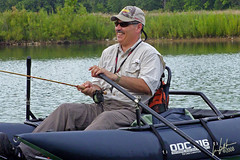
Joe Cornwall fishing Fairfield Lake #1 w/ Les Booth
Joe Cornwall fishing Fairfield Lake #1
w/ Les Booth"

Joe Cornwall publishes a top-class web site full of interesting, useful and timely content called, Fly-Fish Ohio. Joe is an outstanding fly-tier and has a real talent for thoroughly engaging the student in both technique and conversation. His video segments on fly-tying are not to be passed up. As well, his podcasts are truly among the top 10 of all podcasts on the Internet. Give Joe's website a visit and take in his offerings. You will not be disappointed.

He is also the author of one of the best books on warmwater fly-fishing I've ever read (Fly Fishing Warm Water Rivers) you can find more information on the book and how to purchase it on his web site, too.

Tuesday, December 18, 2007

Words of Wisdom ...

Dave Richey preparing to photograph a big muskie My good friend and colleague, Dave Richey has been 'off-line' for a while, as his blog was being rebuilt. He's now back in the saddle and riding as straight as ever.

His first blog in weeks demonstrates that when you're 'hot' - you're hot! No time away, no matter how aggravating to him, dampened, nor burred his writing edge.

This is not only classic Richey writing, but it's just good sense. Real good sense. And since Dave is a living example of both tenacity, talent and tested in said topic - his words are very well worth reading ... and heading close attention to.

Read Dave's latest piece, Never Take Your Vision for Granted and dip into the dozens of other postings on his newly updated site at Outdoors With Dave Richey. And to keep up on his move into the New Media horizon, keep an eye on his new web site, too: Dave Richey OUTDOORS.

Following Dave's good sense advice, we should - as well - never take for granted the availability of such good writing as found in every Dave Richey article and post.

O'fieldstream

PS... Dave has a regular gig now, writing the Sunday column for the Traverse City (MI) Record-Eagle newspaper. If you don't subscribe to the TR Record-Eagle, you can catch his article and links to his blog on the paper's website. Dave pieces are under: Outdoors. Dave is the Outdoor/Local Columnist for the Record-Eagle.

Thursday, September 20, 2007

O'fieldstream Meets Dave Richey

The past week I ventured north of my normal parallel, to the lands of the tip of the mitten in lower Michigan; not to be confused with the UP - that would be the Upper Peninsula of Michigan. I stopped just south of that fair land to venture near the near southern shores of Gichigoomi ... near the beautiful little town on north shores of Lake Michigan, called Traverse City.

My mission was to meet up with, spend a few days with and lend a hand to a legendary wordsmith of outdoor writing, literature and sage advice on all things natural and otherwise outdoors. This legend also happens to be a very good friend and collegue in the Outdoor Writers Association of America. This sage outdoor writer is none other than one of outdoor writings humble and gracious giants: Dave Richey.

Here is a short interview, on some random topics, with the venerate Wordsmith of Michigan.

O'fieldstream: So, Dave, if we were to go afield today for - say, Pike - where would we go and what would be your choice of bait?

Dave Richey: If we would be fishing, it would be in nearby Green Lake. My choice of fishing lures is the old-time red-and-white Dardevle, a proven pike lure. We would surely get into some very nice fish just before sundown. Demonstrating once again the trusty Dardevle's beastly prowess would prove to save the day.

O'fieldstream: But, alas this was a business trip and we are indoors for the duration. The next time I come up we will have to get outdoors. So, with fall hunting season barreling down upon us, what do you have planned for this years fall deer hunt?

Dave Richey: We had a neighbor boy dig us a shooting pit not 100 yards from the back door. It's deep and large enough to accommodate complete concealment and freedom of shooting. The target distance is within an easy 20 yards. We had to cut trees out for our satellite hook-up, so I decided to convert the open area to deer forage. We planted clover and wild beets. It's amazing how much they've grown in the short time. We expect to see deer moving through any day now.

O'fieldstream: I walked that 'plot' with you today and it looks really good. So, what are your chances for a deer in there?
Dave Richey: Well, if the deer comes through, I or Kay will get the deer. In thirty-one years of hunting I've only needed one shot to kill, with a bow or gun, every deer I've hit. But, we'll have to see if the deer choose to walk the 'path' first.

O'fieldstream: You all have had some nice rains up here in the upper Michigan Thumb over the past couple of weeks. Have the salmon begun to move? And how do you fish for them?

Dave Richey: Yes we have; much needed, too. It's been a very dry here in this section of Michigan - as it has been in many places around the country. As to the salmon, yes, they have begun to move. As you know, if you were not leaving on Wednesday we could take advantage of a slot on the Bessie River. I will be fishing there on Thursday. We will use the regular compliment. Near the mouth we use the spawn-sack bait. It's highly effective and is not intended to offer anything but harvest as a result of catching the fish. But this year I want to test out and develop a method for taking salmon, further up the river, on a dry fly. It will be difficult but I believe it will also be a great addition to the fun of the season.

O'fieldstream: Wow! Trib driven salmon on the dry. Now, that would be a noted accomplishment. Not only do I want to see it - I want to do that, too!

More on this interview later.

[Update: Sixteen salmon succumb to Dave's and companions presentations on their day on the Bessie. A joyful start to what will be a fine season of fishing.]

There is one cloud though, still hanging over Dave's fishing season this year - and every season for years to come.
Four years ago, on 10 September 2003, Dave's twin brother, George Richey, a noted fisherman, entrepreneur and outdoor writer in his own right, succumb to cancer. Dave lost his best friend and closest outdoor companion. He still misses George dearly, but he continues to hunt and fish with the memory of George by his side; in each and every season.

So, if you're dealing with such a loss, take a lead from Dave, there is no better commemorative that you can bequeath to your loved one's memory, than to keep the Heritage alive. Go fishing, hunting or whatever outdoor activity you do and be sure to Pass It On to a younger member of your neighborhood, family or friends. Passing on the love for our Outdoor Heritage is, to be sure, one of the finest gifts you can give in the memory of your lost companion.

Happy days afield or stream ... enjoy each day- no more will be added than those you spend afield or stream.

O'fieldstream

Wednesday, July 11, 2007

What Happened to the, "Peaceful Walk in the Woods" ?

I read this morning, on the FlyFish@ (FF@) newsgroup list, a comment about, Women and their safety in the out of doors.

The author of the comments, Kim McDonald, an FF@ list member, pointed to the murders of a friend and her daughter in the area of Pinnacle Lake Trail near Mount Pilchuck in the Mount Baker-Snoqualmie National Forest, about 20 miles east of Granite Falls, Washington.

This senseless double homicide took place over a year ago and still no answers have surfaced as to the identity of the killer(s) or any indication as to motive - other than random mayhem. This is the most fearful part of this incident:
Who did it and Why? Because whomever is responsible is still out there.

Anyone who maintains a regular, active schedule in the woods and on the trails around the country - or at least keeps tabs on those who do - is painfully aware that a '
...peaceful walk in the woods' is becoming a very rare item.

  • It's not only Bambi who needs to fear 'man in the woods', but we ourselves.

It's not bedlam out there, at least not yet; at least not everywhere.

I can name a couple of dozen national and state forests, within close proximity to large urban areas; including most urban parks; that I would be _extremely_ hesitant about walking alone in without '
protection' of some kind. And, contrary to some thinking, the _last_ thing we need is an 'armed populace' walking the woods, forests, trails and parks !!!

Anyone who hunts east of the Big Muddy knows what it's like, even in a legally supported time frame, to be in the 'woods' with the average less-than-prepared possessor of a license and weapon during hunting season! There are entire areas of states - in the mid-west - where
I REFUSE to hunt because of the density of imbecilic purchasers of hunting licenses and weaponry.

  • Note, I DID NOT refer to these persons as, Hunters... they're NOT!!!

This group of 'Yayhoos' - the group I've referred to as
"K-Mart Killers" for a number of years - don't hunt .. they only want to '...kill something!'.

These are the folks who go to K-Mart (or insert your own favorite Department store or Sporting Goods Store) and buy a gun, the week before the 'kill' (in some places the night before a 'kill' - yes, amazingly, there are still places you can do this!), and a box (or 10!) of shells to go 'kill' what they have no knowledge of except they want to,
"...kill something!". And that 'something' may or may not be on the license they purchased.

Thus in both cases: whether, the
Urban Danger Zone and the Mid-West Killing Fields, I choose not to enter. I chose to stay away for two reasons:

  1. I don't really have a 'death wish'
  2. I don't want to go to prison!

However, there is a huge flaw in my choice of action (no-action); and I know this. Therefore, I am as guilty as anyone else of fanning the underground-infero that continues to burn our eyes with its regular release of putrid, acrid smoke of the social fires they ignite and let smolder.

That 'flaw' is this...

  • The more the 'healthy' elements of a populace withdraw, the more the 'unhealthy' elements will expand.

This action, understandably done in an act of 'self-preservation', is actually
APPROVAL by ABDICATION.

When a populace refrains from, refuses or is afraid-to speak out _against_ something that runs contrary to healthy citizenship and society, then that action is, by default, given
carte blanche approval to those committing the unhealthy actions, to continue on, unabated.

  • Silence is golden; in a number of ways. It is also a double-edged sword.

If our society wants something to fear, then we should be 'very afraid' to not become imbalanced in our observance of _silence_
--- for whatever reason. Feel free to insert one or several of the other, often overused and little understood, words flaunted so easily on social conversations today, such as: tolerance, acceptance, open-mindedness, indulgence, lenience ... to name a few.. No, I don't prescribe we return to society run by bigotry, hatred and ignorance. That would be going backwards into the 'other ditch'! But, at the same time we don't need to jump clear across the 'line of social balance' and into the opposite ditch, either. There is a healthy social balance. Be we seem - dare I say - Doomed! - to repeat the mistakes of preceeding history. We just do not seem to grasp the concept that, behavior modification is not the same thing as behavior legislation.

Above all -
the reason to keep silent, MUST NEVER BE OUT OF FEAR. For when fear becomes society's driving force, that which is needed to reverse such a trend, is often far more frightening and destructive than the original cause of the fear itself.

A 'fear', which in many - if not most - cases is only a 'perceived thing' that is feared. Not a real entity to fear, but only an imagined entity.

Kim McDonalds's comments were made in response to a thread of discussions, stemming from an earlier post on the FF@ list. Long-time list member Dave Lewis posted a story of a recent, 'less-than-pleasant', encounter he had with two large dogs, near his home in West Yellowstone, MT. Dave also said the 'encounter' with the dogs' owners didn't offer much in the way of 'comfort', either.

Most of the ensuing comments were related to encounters with 'wild animals', but Kim addresses a very important and serious topic of having dogs on trails in the outdoors.

I can understand how Kim and other women - and quite frankly many men - would feel more 'comfortable' venturing into the outdoors with their canine companions. But, ONLY IF those canines are well-trained, under competent voice and hand command, and either
on-leash or within range and able to respond to command, allowing them to be 'put on leash' - if, and when, a human-encounter occurs.

This brings up the question, "What constitutes being 'armed' in the outdoors?" Is it only relegated to those who carry weapons that shoot bullets or buckshot? Or maybe to include the newer technolgies of pepper-spray cannisters or Taser-type stun-guns? Is it unrealistic to look at canine companions as 'armament' when walking the trails? I don't think so. Because, most people - and I would think the female population would be the highest percentage here - would have their canine companion, on a trail, as much for 'protection' as 'companionship'.

I submit that being 'armed on the trail' can be defined as possessing anything - on your 'person' or within quick access as needed - that could serve as an item of protection (aka, weapon) in the event you find yourself being physically threatened. Am I against this? My answer is a qualified, "No, not necessarily. But I believe we should be very careful in our mental attitude toward 'protection' as much. We need to limit the 'types of protection' we are willing to employ."

I have no objection whatsoever to a person taking whatever means necessary to defend themselves against physical harm. Be it a pop-cicle stick or a .44Magnum. BUT ... and this is a BIG BUT!!! ... every person who ventures into areas of questionable safety - or areas with such potential: and frankly folks, because of the variables in life, that's about anyplace on this orbiting blue ball!: should be well versed in how to protect themselves by doing the LEAST AMOUNT OF DAMAGE NECESSARY. Deadly action is NOT LEAST AMOUNT! A .44Mag is NOT LEAST AMOUNT!

But in the case of the two women tragically murdered - a canine companion - may or may not have prevented their deaths.. or even limited their injury. Dogs are susceptible to high-speed lead projectiles, too. Both women were shot. A dog could well have been shot as well.

It is terribly unfortunate, that our society has become such a 'clouded quagmire' of unknowns. The resultant dilemma, is a populace left wondering what they can do and at the same time falling under the paralyzing grip of fear; immobilizing most of us into doing nothing.

Discussions like this run the familiar path as Kim says in this part of her comment,

  • "Sorry, it [this] is one of those disputes on this list, like many others, where there are different opinions. There are certainly isolated cases of bad behavior of dogs and dog owners, just as there are isolated cases of bad behavior of just about everyone."

The most unfortunate thing is that humanity has left the trail of self-control. Getting back on the trail requires a serious change of mind. And Change is the most feared element on the human stage of life. Yet, it's only through Change that humans will ever realize the benefits of self-control, and all that we seek. Thus, we are living in the grip of a raging Catch-22.

So... what will be the generator of our necessary, 'Escape Velocity' ? Doubtless it will be a '...peaceful walk in the woods' .

O'fieldstream

Powered by ScribeFire.

Thursday, June 07, 2007

Indiana Rivers Rally: Day One

Indiana Rivers and Water Quality , Jane Frankenburger

Comments on Water Quality: (get date)
Water Quality: 1) not good enough 2) not well enough understood 3) conference should bring people together to work on answers.

Fish and Mussels in Indiana Rivers, Brant Fisher, IDNR

211 species of fishes in IN rivers; many are invasive species compared to those located in the native rivers and streams before European colonization.

Four major drainages in IN: Kanakee, Ohio, L Michigan L. Erie

Indiana streams and rivers have a very diverse and abundant list of fish. The minnow family is quite abundant, with many of the darters, sunfish, the lake sturgeon are on the endangered species list.

Typical cross-section of fishes are the darters, minnows, sunfish, sucker and catfish. A few others species are found in various waters.

Mussels 19 expterpated, 6 endangered, 9 special concern. With the Ohio taking the hardest hit with exterpation. Clubshell mussel is a good example of a once wide ranging specie that is now relegated to only two streams: Fish Creek and Tippecanoe River.

The challenges and opportunities for Indiana rivers and streams is the same as we've had for years. It's just now that we need to get more people educated and in-line with the programs of interest.

Recreation and Indiana Rivers, Steve Morris IDNR Outdoor Recreation

96% of the land in Indiana is privately owned. This has a large impact on the recreation opportunities for Hoosiers.

Roughly 400K Hoosiers canoe and/or kayak. Doing the math from 6.3M Hoosiers, there are 19% of them who canoe or kayak.

Water Trail information is found in the IDNR's Hoosiers On The Move program.

Hoosiers show an interesting statistic in Indiana. Roughly 3M Hoosiers are also fisherman. The second most used reason for boating in IN is for fishing.

Ted Lebberman, contact to provide ideas and comments.

Indiana Rivers and Our Culture and History, Donn Werling, Allen County Historical Society

Donn's main comment, "... we have the opportunity to make history, not just be a part of it." We must know how to read the natural landscape: under the water and on the banks. The history and heritage that exists in IN must be understood to appreciate it. If we do not understand it - let alone know about it - we will not have a motivation to rebuild, restore and live in harmony with the land.

If we learn to read the land we will then begin to build the understanding for why we need to protect the waters and the land that surrounds it.

Donn mentioned the resource called the The Jesuit Relations and Allied Documents, compiled and edited by Reuben Gold Thwaites in the 19th C. This resource is valuable for pealing back the layers of history.

Donn closed by singing a song he wrote about rivers, "The Rivers we

IN: Economic Development/Tourism, Stan Lambert

The role of rivers in the IN economic history. Stanton provided a presentation on the current status of the economic developments along IN rivers.

Overview of various urban areas that are working on river area developments.

The state of Indiana has in its sights to become the leader in bio-life science and hi-tech industry. To do this, all members of the state must develop a new outlook on the economic approaches accomplished by Hoosiers.

The 'quality of life' factor - used by most companies in their choice of locations, is higher today than ever before.

Q&A

City wastewater treatment plants - bacteria only - or do they have to remove heavy metals and other waste problems? JF... response was totally political. Talk of TMBL's.

Benthic community: restoration post destruction? BF... yes, it can but the data and experience is very limited. Restocking is very difficult due to the variables and large areas
How long do mussels live? BF... growth rings in shell -rough idea: up to 50yrs+

Legal Issues around 'log jams' when using waterways? SM ... trespassing is common, due to using officially non-navigable streams; navigable streams allow it below high-water mark. Other issue: who is responsible for clean-up.

Biggest priority in topic area and what can public do to help?
DW .. Thoreau .. "heaven is under your feet as well as over your head"
JF... get involved in watershed projects.
BF ... anything we can do to improve water quality
SL ... we must have one camp that works together; Stanton used the word 'sustainability' - the idea is good, but we must remove this word from our vocabulary. We do NOT need sustainability, we need IMPROVEMENT.
SM ... bring those who are not in the 'non motorized' community on board.

Rivers Rock Around the World, Dennis Wichelns

No longer with the Rivers Institute but continues to collaborate.

The density of the human footprint, worldwide, is closely tied to the occurrences of water on the earth. Water is essential to life for all of the earth. Water is also closely tied to the development of a country. Many of the nations in Africa have been adversely affected by the lack of navigable waterways. Much of Africa is unpopulated, due to lack of water or too much water and the density of life threatening water borne diseases.

Wichelns explains the problems with water access and hydro-politics around the world, by focusing on the major hot spots around the world. Those hot spots are in the areas of the most densely populated areas on earth. Water and its use form the basis of major challenges in the hot hydro-political spots in the world will have future consequences for the rest of the world.

He also pointed out the problem growing in 3rd World countries making strides to gain position in the global economy while still having population growth well above the ability to handle such variance between industrial growth and human quality of life.

Wicheln pointed out the problem with technological advances being introduced into dense population areas of the world. The idea of tube wells made clean, healthy ground water available to the people in Pakistan. Before the wells, people were dying for lack of safe drinking water and lack of irrigation. Now, because the technology was so successful there is a huge problem with depletion of the ground water. The people will not give up their tube wells and the rivers will not have water forever.

Q&A

What about the melting of glaciers in the Asian water system .. are they reducing due to warming and what are the problems? DW... Yes, they are melting. When the planet warms there will be a huge increase in the water levels coming off the mountains and it will be a years long problem in excess. But when that is done there will be a huge drought as a result: no snowmelt.
What about invasive species in international waterways? DW ...Yes, must be but no his specialty.
International Organizations working to find solutions? DW ... Yes, the UN and CGIAR.ORG World Economic Forum: Water Initiative

Overall a very interesting day. A very good day for the first state-wide conference on rivers, ever held in the state of Indiana. We just hope this will not be the last. We also hope this will become and annual event... at least someplace in the state.

O'fieldstream

Indiana Rivers Rally: Opening Remarks

Opening remarks by: Brent Ladd


The Indiana Rivers Rally is for the people in this room. Indiana has the longest unimpeded waterway east of the Mississippi... the mighty Wabash River. Indiana has more miles of waterways than INDOT has in roadways. This should tell us something.

At the IRR there are between 180 and 200 people in attendance. This is a unique event in the history of Indiana waterways and a long time in coming. This should be a great opportunity for the members of the community who volunteer as well as work in the efforts toward waterways and resource utilization, conservation and preservation.

Comments by Molly Dodge: Hanover College Rivers Institute Co-Chair of the IRR.

Keynote Speaker: Tim Palmer "Rivers of America"

Originally from Pennsylvania, Tim has traveled the country in all directions in search of the rivers of America. Knew nothing about Indiana Rivers until Bill and Marty Mayer showed up at a PA "Dam Rally" .. with concerns for the streams in Indiana that were in danger of being damed and destroyed.

Side show on his journey to become an advocate for rivers and waterways in America.

Rivers are at the root of all people, no matter where they live on planet earth. Whether a river exists in the heartland of flat food producing country or in the idyllic lands of the mountains of the wild west or the slow, lazy flowing waterways of the deep south, to the now acidic waters of the northeast, waterways tug at our very soul. If they are lost, then we become as the father of the land ethic that is enjoying a resurgence, Aldo Leopold said about not wanting to live in a land with wildness.

Thus, for the sake of soul saving events that go far past the esoteric views of a purist, keeping waters flowing free and clean are essential to our very existence.

Tim, during his presentation talks about the efforts he has undertaken on his own personal photo-journey that culminated in his coffee table photo essay book. He is now working on another photo book about the restoration of riparian zones around the watersheds throughout the U.S.

The range of Tim's presentation is enormous and it takes in the full range of waterways .. rivers of life in the U.S., from the deep south to the west; from the northeast to the desert rivers. Then off to the northwest and the wilderness lands of Alaska.


Q&A

What did Tim call "Lake Powell"? Powell Mudhole

Photos taken, how? Mostly from land for best quality. Some from boats; from ladders; skis in the winter .. any way he can get the shot?

How many cameras lost over the years? Only dropped one camera into water. Dropped camera off cliff - but was not damaged. Tim still shoots film; using camera (Canon A-1) from 1984.

How many oars lost? One .. his 'stone-age' oar .. using stones attached the oars to provide 'free' balanced oars.

How did you get around and to all those places? He lived out of his van for 24 years. He and his wife lived out of their car in order to 'be on location'. He and his wife now live in a house in Oregon.

Does he confer with Native Americans? Yes.. wherever and whenever possible.

What are you currently working on now? Photographic book on Trees due out in '08; Sierra Nevada book due out in a few months; published by Heyday Publishing.

O'fieldstream

Indiana Rivers Rally

West Lafayette, IN 7 June 2007

Today is the first day of the 3 day conference which many in the water and resource community has been awaiting for years. The Indiana Rivers Rally conference being held at Purdue University today - 7 June - through Saturday 9 June, is a gathering of the most interested and motivated of people working for the conservation, preservation, restoration and facilitation of Indiana's Hoosier Waterways.

Scientists, municipalities, non-profits and commercial enterprises all, will meet to discuss, debate and plan for the better use of the water and resources supportive to water in Indiana, for now and into the future. Many in the water community have great hope for the promises this meeting should bring about.

We at O'fieldstream are actively involved in the conference and will be reporting on the daily activities. If possible, we will blog directly from the conference. If not we will bring you daily updates. We are, unfortunately, only able to attend the first two (2) days of the conference, but we will obtain a 'stringer' to record the main events of Saturday 9 June in our absense.

Read about the objectives, mission and participants of the Indiana Rivers Rally on their official website. Also, you can read about the various organizations that are pushing this years meeting on the TippeFlyFisher; one of our satellite blogs.

Please... take the time to read about the conference. This will be your only way to find out what is happening at this conference as it is not open to the public. Again, remember this is the first year for the conference. We are sure there will be changes - very good ones at that - coming for the use and conservation of Hoosier waterways. As well, we hope to see next years' conference open up to a broader audience. At least that will be the O'fieldstream input.

Stay tuned ....

O'fieldstream

Monday, September 18, 2006

McCritter - Red Salamander (Endangered) 02: Not!!

----- UPDATE ----- Well, I had to come back to this post and make the corrections that I made on the original photographs. I had erroneously identified this little critter last year when I first posted it - as the rare and endangered Red Salamander (Pseudotriton ruber). However, I recently received an email from Dean Alessandrini, VP of The Greater Cincinnati Herpetological Society, correcting me on the identification. Therefore, I now have the salamander properly labled, as the Cave Salamander, (Eurycea lucifuga). It is found in the limestone cave regions of the midwest and south (shown in map above). A beautiful little amphibian. As Dean stated, its identifying features of wide head, slender body, and large, bulging eyes are obvious. At least part of my comment below was correct. This salamander and all amphibians are truly the 'canaries in the birdcage' detectors of a clean, healthy environment. We are loosing them in ever increasing - and alarming - rates each year. This is something we should all be very concerned about. They may be first .... but we're not that far behind them. O'fieldstream --- original erroneous entry --- This little a rare item in the Hoosierland and well worth preserving. Besides being cute - they are environmental indicators. Even more than humans the skin of amphibians allow the outside environment to pass through their respiratory as well as their skin-air-interface. McCritter - Red Salamander (Endangered) 02 They are our "canary-in-the-birdcage". Let's not kill the our protective alarms.

Muskoka Outdoors Photo Gallery - Your Catch/Big Laker

Muskoka Outdoors Photo Gallery - Your Catch/Big Laker
Bill Anderson, over at Muskoka Outdoors has a new web site you out to take a look at. While there also, take a look at his new Photo Gallery. It's a free gallery - only costs you your email and he will NOT give it out. I was rumaging through it see what was there yet, and found photo at the link above. Whoopee! I want to know the details when Bill gets them. Take a look to see what the buzzz is about.

O'fieldstream

Wednesday, March 29, 2006

Solar Eclipse: Fade to Black and Back

TODAY IS THE DAY.

Today a total solar eclipse may be observed from 08:36 GMT (09:36 BST) to 11:48 GMT (12:48 BST) in Eastern Brazil, West and North Africa, Turkey, Central Asia and Mongolia.

The Total Solar Eclipse of 2006 is underway. The area with the best view will be across Africa, Europe, Middle East and Asia. North, Central and South America will miss out this year; as will Austrailia and the archipeligos of the Pacific. This site is devoted specifically to the March 29, 2006 Solar Eclipse.

For those who would want to venture out to WATCH the eclipse or even PHOTOGRAPH it, follow those links. Be very careful about, 'watching' an eclipse. The full force of the sun can permanently destroy your sight! There are safe ways to accomplish being a witness to this great natural event; they are in the link above on WATCHing the eclipse.

Head to the Weather Underground Photo Gallery to see the picture NOW flowing in showing the eclipse from those areas in which it is visible. WOW! Some super shots already!!!

Weather Underground Photo Gallery also has a Photo Contest going .. check out the 'rules of engagement' HERE.


The Total Eclipse in history have been seen as being a time of great dread and terror. [1].


The term, "Total Eclipse" has come to mean many things, as well. We are a specie that loves to play with our languages, aren't we!


However, a total solar eclipse is a marvel of a nature. NASA's Solar Eclipse Page offers some very interesting data, insight and info. Here's a neat explanation of HOW a solar eclipse occurs.


Wikipedia Info on the Solar Eclipse is really cool! They have the animated graphic for tracking the path of the total solar eclipse.


If you've been fortunatre enough to have the opportunity to observer - first hand - this stellar event of nature, then post your comments. Include links to photos that you've made or you've found that others have made. I look forward to the next time we in North America have the opportunity to observe and record this great natural event.


O'fieldstream

Wednesday, March 08, 2006

Iditarod 34 - Off and Running!

Saturday 04 March 2006 was a boiling mass of fans, dogs, mushers and supplies lining the streets of downtown Anchorage, Alaska. All in anticipation of the 34th Running of the Last Great Race .. the Iditarod Dogsled Race. 1,112 miles from Anchorage to Nome. A grueling, tough, dangerous and unpredictable run for the finish line.

This year the snow conditions in Alaska have been so abysmal that 4-6 inches of snow had to hauled into Anchorage from the surrounding mountains to fill the streets so the ceremonial start could take place in Anchorage. I don't know how far this 'snow route' had to be man-made - but the trip went 17 miles from downtown Anchorage - D and 5th Streets. The Sunday start was moved to Willow in order to have the snow cover needed.

On Sunday afternoon at 2 PM Alaska Time (GMT -9) - "The Last Great Race" began for the 34th time since it's first race in 1973. The weather was not cold but sunny and clear. The snow was good for a start and the race began with the usual gusto of new mushers, veterans and new gadgets. Among the most interesting things showing up at Iditarod was the dog mushing styles this year. The Swede win last year by Robert Sorlie, brought back a slower trained dog with longer running times and quicker recovery. Jeff King let it be known that was the regimine his dogs were doing this year. So .. will it work? That is yet to be seen.

The trail has posed a number of surprises. Sections that were normally worry some - and last year were downright destructive - were pretty good this year. The sections that were troubling in 2005 were not so this year - and what was easy in '05, have been true thorns this year.

What awaits them as the mushers and teams dash down the trails across the Alaskan wilderness, is anyone's guess now. But we can all be sure it'll not be alligators, snakes and hot weather!

O'fieldstream


Wednesday, October 12, 2005

White-water Kayakers .. Head Smarts Means LIFE

The high-volume rush of water, tumbling over rocks at steep incline, in a constrained space, builds the playground for one of the most exhilerating, fastest growing and dangerous sports in the world This outdoor activity is known as white-water (W-W) kayaking. Thousands of people have rushed to enjoy the sport of W-W and each year there are deaths. Most of these deaths are attributed to drowning, but a good number also show the drowning occured following a blow-to-the-head. Many kayakers - if not most - wear helmets. So - why are there so many deaths when the participant is wearing protective gear? Maybe the gear is not as up-to-the-task of protecting as we think.

In 1998, Lucas Turner was killed on the North Fork of the Payette river when his boat fliped, he was ejected and his head hit a rock with the fatal blow. But how could this happen? This was a common occurance. What happened? Well for one thing the helmet Lucas was wearing was pushed back on his head - exposing his forehead to the full impact on the rock. This was clearly a design issue.

Lucas's father, Gil Turner of Park City, UT sought answers and a solution. His quest took him to Johns Hopkins University, in Baltimore, Maryland. Two graduate engineering students took on the
task of designing a new, safer W-W Kayaking helmet.

I've been kayaking - both white-water (W-W), river and sea, since 1974. It's a great activity; from very challenging to just plain enjoyable. The thrills, spills and chills are real attractant to those int the X-treme sports. With W-W kayaking being one of the fastest growing outdoor sports worldwide, so too comes with it the dangers of big water, fast current, hydraulics, hypothermia and big rocks. A clean run can mean nothing more than an adrenaline pumping experience that will thrash you for days. But a bad run can leave you either dazed or dead.

I've kayaked the Main Fork of the Payette, it's no where near the technical or dangerous water found in the North Fork of the Payette, but it is still a river that should NOT be taken lightly. My son and I were there in 1995 while on a pre-trip planning session on the Missouri River (a long, sad story for another time). The day we ran the North Fork was beautiful; bright sun, blue skies and the water running at about 2800 cfm. My son had never been in white-water in a kayak before and I was more than a little concerned for his safety. He was very athetic and used to water, being an avid wind surfer - but the hydralics of white-water are much different than what a wind surfer is used to. So we chose to put in on a relatively calm section, do a modest 5 mile shoot and hitch a ride back to the truck.

First note ... I'd personally not been in white-water for at least 6 years and never in the new Dagger Responses we were using for the first time. I'd also never kayaked white-water west of the Mississippi River. So, I was taking a risk on 3-major areas: 1) out of shape 2) unfamiliar equipment and area 3) unskilled companion. But we went anyway.

We put in just above a nice chute that looked to be nothing more than a gentle Class III. However, when we got into it - it was anything but 'gentle' ! My son - being younger and more agile - wisely took a route around the main chute and passed through it a 'glancing blow', without any trouble. I, on the other-hand, was heavier in the boat than I should have been, was paying most of my attention on seeing how 'my son was doing' than on the river and ended up going right through the midst of the chute. I was a fun ride - until - I had a unexpected encounter a rock that rolled over in an instant.

My 'kayak-roll' was never great, but it was generally adequate for the lesser-hydraulics of most eastern waters. It wasn't for this river! I soon began to stuggle. This compounded the situation. I was eventually able to do a 'deep-water-ditch' and made it, drawn-and-exhausted to the shore. We had neglected to procure bladders for the boats to aid in floatation and I learned just how valuable that would have been! I was able to get my boat and self to the shore. But I was totally exhausted. And - at that time - I had no idea where my son was. I was frankly very frightened. But I could do nothing at the moment but set in the sun, get warm, catch my breath and get enough energy to walk down-stream, put back in the calmer water and find him: hopefully, well.

I did find him. He was absolutely ecstatic! He'd had a maverlous run and was pumped to run the water for the next 4.5 miles of the trip - and probably do it 2 or 3 times again. I on the other-hand, was wiped out: physically and emotionally. I'd NEVER felt like that before on white-water. And I have had my share of 'close-calls'. But this one showed me I really had no business being on this water - in as poor a physical condition as I was. I made a tough call: we were through. My son was NOT happy and did NOT understand. I stood my ground and explained to him that though he was probably fine with the experience, I was neither about to let him paddle on his own - or attempt to make the same mistake again for myself. He acquiesced - but still was pretty hot about me 'spoiling' his fun day; he still is, 11 years later. But he's still alive, too. He had no idea how much I hated to do that to him - but I just could not go back myself. Sobered and shaken we made it back to the truck and into McCall, ID for the night.

I learned a big lesson that day on the Payette River and I am most grateful that neither I, nor my son, had to pay the expense of that lesson with either our lives or serious injury.

Using one's head pays off in lifelong ... even long life ... dividends.

O'fieldstream

Saturday, September 03, 2005

Open Letter to Dave Winer & the Community Blogosphere

Dave ..

If you're reading this email ... PLEASE READ THIS!

We thought 9/11 was an event where blogging and podcasting could and did serve a great need, well, Katrina is the REAL PROVING GROUND. There are needs .. HUGE needs .. and they are NOT ALL centered in New Orleans !!!


As you well know - the Media is a one-sided, cycloptic monster. It only sees - all at once we must admit !! - in one direction. There are many stories of pain and suffering - atrocities we thought we'd never see in this country. But one of the most troubling, new development - is that the US Government Military is STOPPING and not allowing help to enter the areas, coming from family members and other citizens of the US. These are caravans of supplies needed - by those in the affected areas - to sustain life and rebuild their communities so life can struggle to its feet and make a lunge for some semblance of normalcy. People in these hardly accessible areas - such as Gulfport, MS - are DEPENDING on these supply lines getting through. It has become obvious that the lack of leadership from the highest levels of the US government to the local level are NOT going to do all that is needed to be done.

The WORD must go out to LET THE AMERICAN people help. And those who DO HAVE the connections - so well developed through their business contacts and many years of experience - DO NOT HINDER their actions to move forward in their - and their neighbors - struggle to recover.

I am in contact with a young lady - now in Atlanta - whose parents are still in Gulfport. They were very fortunate to have ridden out the hurricane and survived with their house to remain standing; scathed, but standing. If this were not bad enough, they now must take up 24-hr vigils to keep the thieves and vandals out of their home (read her entries 1 2 3). Understand, this is NOT about food and water - it is about property abduction .. shear theft: nothing else. This is NOT an isolated incident and it is NOT happening ONLY in New Orleans - it is happening all over Ocean Springs, Biloxi, Gulfport, Long Beach, Pass Christian, Bay St. Louis. Hell look at it, it's all the way from Mobile, Alabama to New Orleans (just do a Google on Gulfport - go to the Google Map and back OUT 3-cliks and you'll see the area of devastation - not just destruction - but DEVASTATION!) - this WHOLE area has been devastated and is becoming a wasteland overrun by thieves and thugs preying upon the survivors of Katrina's wake of destruction !

You're the KING of the Blogosphere .. like it or not. When 'Dave speaks' the blogging community and the blogosphere LISTENS! Speak out! Speak out now! Get the blogosphere humming with the news of this GROWING disaster. Katrina is gone from the map .. but SHE IS NOT GONE! Her wake is still reeling from the pummeling she gave this entire region.


If the WORD is not gotten out .. and I do mean the TRUE WORD .. the HONEST comments and stories of WHAT IS happening on the ground and in the backgrounds of humanity in these areas --- the fallout will reach from sea-to-not-so-shining-sea, from border-to-tenuous-border !!! This is an IMMENSE NATIONAL DISASTER that is STILL IN THE MAKING. But we CAN yet STOP the 2nd Wave of Katrina's Disaster .. the Human Reaction to the obvious, Inactive Leadership Vacuum, found at every level of government in this country.


I am sad to say it... but this is NOT a UNITED States of America ... it IS a very troubled and perilously close to dis-United States of America! A continuous line of communication MUST BE opened and the MEDIA must - ONCE AGAIN be moved off their hype position and MOVE the government to do what they are in-place to do .. SERVE THE PEOPLE OF the USA!! ALL THE PEOPLE!


Yes .. I am blogging this on two blogs:


The O'fieldstream Blog
http://ofieldstream.blogspot.com
http://www.ofieldstream.com/ofsblog

and

Weather & Outdoor Heritage .. It's Life
http://www.wunderground.com/blog/ofieldstream/show.htm

I'm working with Doug Kaye as
'mentored junior editor' on his IT Conversations and I'm sending him this email as well. I'm also sending it to all the major bloggers I know and know of. I am hoping - PRAYING - that the blogging and podcasting communities join together to Become the FORCE for ACTION - not revolt - ACTION to get the wheels of bureaucracy freed up and turning for the good of the American people who PAY to have it work for them.

I'm listening right now to Geraldo Rivera claiming the wonders of the chopper FINALLY arriving to take the 25,000! people - they are NOT REFUGEES! - they are SURVIVORS - Human Beings - Citizens of the USA - out of that fetid hell-hole to a place that is cleaner, safer and a chance to make a new start. The logistics of this entire Event .. is a nightmare. But we are NOT going to be able to wakeup from it ... it IS REAL! And IT IS NOW!


Thanks for your help. Let's hope, pray and work our asses off to get this moving. If we don't WE ALL WILL LOOSE .. and LOOSE B I G !!


les booth
aka, O'fieldstream


Friday, September 02, 2005

In for the LONG HAUL

Here we are - Thursday Sept 1, 2005 .. just now 4 days into the aftermath of hurricane Katrina ... and we are seeing the signs of our fragile social fabric - tearing under the stress. These were the same words used last night on the CBS Evening News - when veteran reporter, Harry Smith - stationed in Gulfport, MS - gave the wrap-up on his report for the day.

FOUR DAYS!! Only 4 days. Let's picture this. Yes, it's a very short time in considering the rebuild scale that will be needed. But on the human level .. that means - for those who do NOT have food - even if healthy - it's 1/5 of the way to starvation. For those without water .. it's already half-way to dying of thirst! So .. it's a far more dangerous number than we first imagine. And that is the ONLY perspective that it should be viewed from. People are dying in the streets of New Orleans and the devasted regions not yet even seen by anyone but those who are suffering in seemingly their own lone positions. This is a human tragedy... not an economc one. That will come later.

Remember NONE of this takes into consideration the likelyhood of disease from the decaying corspes littering the area; the fetid waters filled with chemicals, fecal matter, and decay. The animals that will either be dying - are dead - or who will begin feeding on both the dead, dying and living. This is a very grim condition. And we do NOT have time to play 'government games'. If people are to be rescued and given a chance at survival there is no place for buracracy. But we all know it will happen - it is happening - and it will continue to happen.

So the big question we need to address is " IF we are seeing this kind of meltdown now .. What are we going to be seeing/doing at 4-Weeks .. 4-Months ... 4-YEARS !! ???

Yes - there are hundreds of acts of heroism, selfless service to those in dire need, and the most needed 'acts of kindness' - that go unreported. But all of us have -at one time or another- been in need. We've been on the receiving end of the kindness of friends, relatives and neighbors. And we've also seen 'them disappear' as the days - weeks and yes, years - drug on.

A care-giver - no matter at what level - or at what task, must be IN IT for the LONG HAUL. Once a person is in the need of 'care' - true, honest, life-sustaining care ... they need help and a helping hand then - and will need it for some time to come. Also, many will need that help a lot longer than others. Then there are those who will take advantage of the kindess - and 'bleed' the care-giver to death - if left unchecked.

Unfortunately we have and we will continue to see this dispicable behavior: it's all part of the human canvas we call life. It's not pretty - but it's still there. And unless we are ALL in the effort for the LONG HAUL - we will only look at the ingreats, the despicable and the seemingly 'down the rathole' efforts poured forth. And NOT ONE of us can afford to walk that path. Because IF we do - we will ALL LOOSE.

So ... from the 'get go' .. let's all realize this is a NATIONAL DISASTER - of scale that only Hollywood could show us. It is not apocolyptic ... but it is of the size and scope that will leave this country changed forever. It is NOT just a local problem. I do not live on the Gulf Coast - for a very specific reason - I personally know the damage nature's fury can inflict and I do NOT want to be the recipient of that onslaught. Therefore I chose not to live there.

HOWEVER ... the misery and the pain being felt there at this very moment IS MY PROBLEM, TOO. And I'm not talking about the price increase at the gas pump. I'm talking about the suffering of the people who have survived this natural disaster is MY SUFFERING, too.

Those affected,are PEOPLE I personally know. They are parents, grandparents, wives, husbands, brothers and sisters, sons and daughters .. all elements of the human family. They are citizens of the United States - but more importantly - they are ALL citizens of the Human Race! They are all my fellow human beings. I cannot - therefore - with a clear conscience .. because I do have one .. just toss my $5 or $500 into the Red Cross cauffers and say, "There, I've done my part." and let it be at that.

NO!!

The problems - and make no mistake about it - these are EXTREMELY serious PROBLEMS! - are not going to be fixed in a month - or even in a year. It will take years ... even our President had to come that conclusion - and probably to the horror of his policy advisors - said so on national TV yesterday at a press conference. It will be Y E A R S before the stretch of the Gulf Coast blasted, by Katrina, will be viable. And, too, we have to remember that there are hundereds - if not thousands - of square miles of devastation that has not yet been shown.

So - as individuals - and as a collective nation - when we reach our hands out to those in need - had better be ready to maintain that position for many months to come.

If you don't understand WHY we need to do this .. then I am truly sorry for you. Your upbringing was sorely shortchanged! In case you still don't know WHY .. well, it's nothing complicated .. it's just the right thing to do. Nothing more gand than that ... and yet knowing that and acting upon it is the most powerful force in humanity. Let's hope and pray we never loose sight of it.

And yes .. this IS what the Outdoor Heritage is all about. It's about knowing our roll in the scheme of life. One of those rolls is that we cannot take the position of 'Sole Survivor' .. for if we do, we may well find ourselves the 'Sole Survivor' and that would - in true REALITY - not be a place to aspire to.

Just to give both sides of the coin a good look ... there's a 'selfish' reason one could take for helping out: One never knows when he or she will be on the needy-side looking up for help. There is an old, old saying that is every bit as viable today as it was the first time it was uttered - whenever that was : "What goes around, comes around." Let's not ever forget this either.

These are hard words. Hard questions. And these are much harder times. As much money as is poured into the preparations for disasters - why was there not put into place - ready to move in a moments notice - from a major military base well out of the reach of the hurricane's path - that could be brought to bare on the immediate needs within hours of assessment. We may not have seen the pictures of the devastation on TV for hours or until the next day -but there were helicopters and airplanes who DID see it and could have started the immediate responders in-motion THEN: not 4-days later.

What are we going to do WHEN - we get hit with another big one like this - say into Miami - and then hours or days later an earthquake hits LA or SanFran or Seattle? No, we sure don't want to think about that do we? Well - the REALITY is this - nature doesn't care whether we want to think about - it's just doing it's thing: day-in-and-day-out. And IF the earth mantle makes a sudden movement that results in an 8.0 in the LA basin, just hours after a hurricane Cat 4 takes on Miami and all surrounding counties - hey, that's tough. You all know the saying, "Shit happens." The only question that is viable is - 'How well can you dance to the music?" In other words - are we - as individuals - prepared to fend for ourselves AND our neighbors?

If nothing else has been shown by this calamity is has been this: "We are not a cohesive unit of people - at the ground level - when we need to be." There are pockets of those who DO function well - with anyone around them - as best they can - but this quality of character is becoming a rare commodity in our soceity. IF we do not recognize this and take immediate steps to correct it - then we are digging a hole and setting in it - waiting for when the 'dikes' will break and swamp us. Then it will be too, late.

I am not being negative. Never confuse the courage to face the facts of reality for negativism. My comments here are made in the hope that we see where we need to make changes. Changes that will prevent the exacerbation of pain, misery and death in the face of huge natural calamities that we as humans have absolutely no control over. But we do have control over US - and how we deal, individualy and collectively with the 'morning after'.

There are answers - we, as a the human-community- just need to grasp hold of those answers and put them back into force in our society ... and we must do it NOW.

God speed to all who are providing the services needed and let's all be sure we are NOT doing anything to jeapordize or hinder that one bit.

ofieldstream

Weather Underground Photos of New Orleans

If y'all haven't looked at the Wunder Photos Very Important Photos, then you need to. SmithFarm Photos, a Fish & Wildlife employee, has uploaded an extensive gallery of photos of the condtions - on-th-ground - in New Orleans. SFP did not label each photo extensively - the Captions are a repeat - but the photos are very descriptive. As well - I find the Caption itself very telling.

Take a look ... this is what 'one of our own' ... IS doing on-the-ground in the ravaged New Orleans area.

These are but a few of the many ...

O'fieldstream


Thursday, September 01, 2005

Links in Previous Post ...

I apologize that the links in the previous post did not come through ... here are the URLs:

CNN interview w/Dr. Ivor van Heerden
http://www.cnn.com/2005/WEATHER/08/28/katrina.doomsday/ (posted on 29 Aug 2005)

CNN video interview w/ Mr. Walter Maestri [click link after 1st paragraph in at the link above] (this is from a 2004 interview! ) -- this IS a chilling commentary. We ARE NOW seeing it - it has happened!

Sorry for the technical clitch ...

ofieldstream

They Knew, Did Nothing: Tip of Many such 'icebergs'

I know - professionally- the director of Louisiana State University's Hurricane Center, Dr. Ivor van Heerden; he's also the director fo the Center for the Study of Public Health Impacts of Hurricanes, located in Baton Rouge. He gave .. and has been GIVING a report on the impending disaster - for the past 20 years - we're are now deep into with New Orleans.

I will make a comment on his studies - that of several others - and what I've been involved in myself, later.

But for now ... I want to pass along this CNN interview report with Dr. van Heerden and a video interview with Mr. Walter Maestri, Director of Emergency Management for Jefferson Parish; nearly a 500,000 populace-part of New Orleans.

To say, "I told you so."- may be too painful for people to hear, but once you view this video and read the article - you will come to no other conclusion that just that.

CNN interview w/Dr. Ivor van Heerden (posted on 29 Aug 2005)
CNN video interview w/ Mr. Walter Maestri [click link after 1st paragraph] (this is from a 2004 interview! ) -- this IS a chilling commentary. We ARE NOW seeing it - it has happened!

[NOTE: I don't know when the interview with Dr. van Heerden was 'actually' conducted, but I DO know this information has been around for over 30 years ..and, at this level of seriousness! Hurricane Betsy in 1965 - killed 61 people and forced the levee system constructed - and ever since then EVERYONE knew they were were NOT enough. The computer models showed a Cat 4 direct hit would kill no fewer than 44,000 people in New Orleans - ALONE! ]

This is incredibly sad. And we are in no way seeing the 'only' such case of this level of 'osteriching'. This is one .. of many 'icebergs' floating around in the ocean of our society. We are in danger.. from so many fronts. And we've played osterich for so long. We are 'over due'.

I think we can say ... 'stike two'. We all know the next call ...

ofieldstream